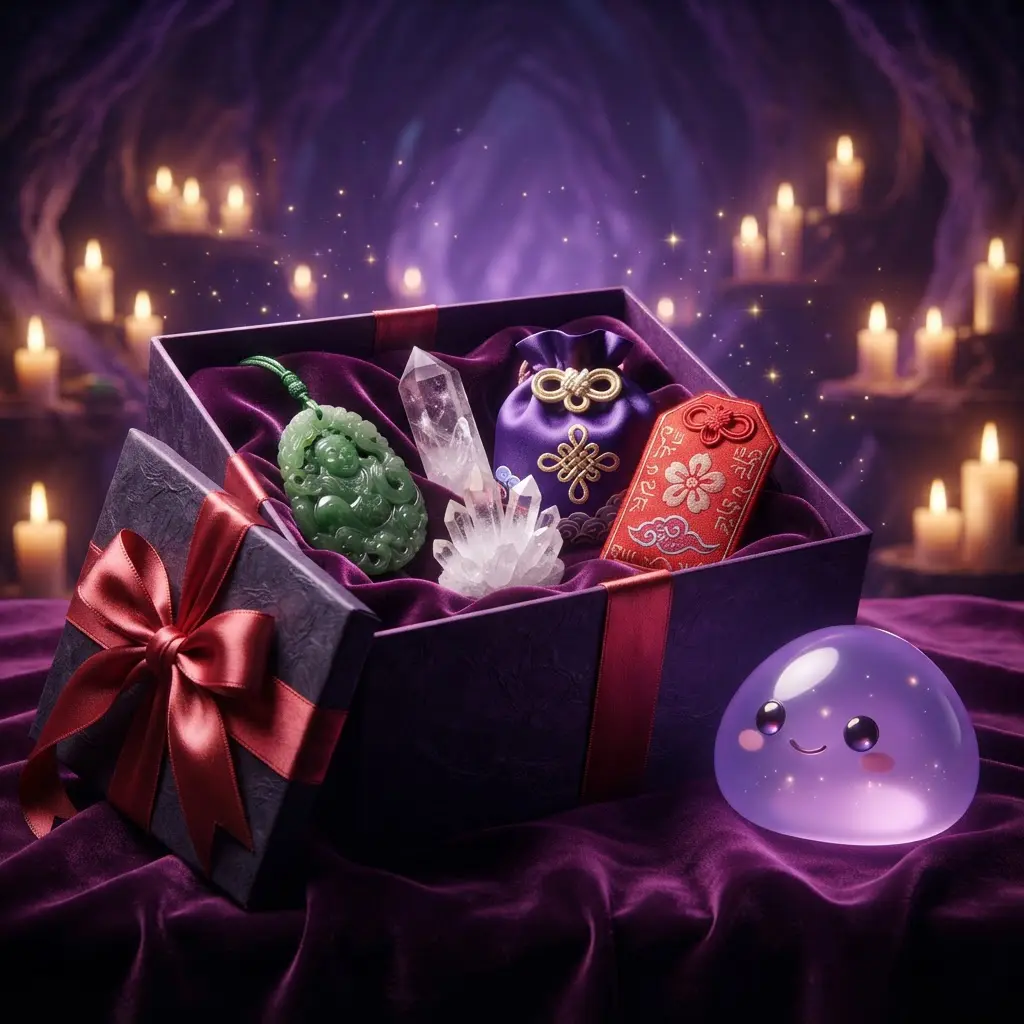
What This Article Is About
During holidays, when a friend moves into a new home, or on an elder's birthday, many people think of giving a lucky charm to show they care. But jade, crystals, omamori (Omamori, 御守), and talismans (Fuzhou, 符咒) each have their own nature, and giving the wrong one is not only awkward, it can also put the other person in a difficult spot. This piece helps you draw a clear line, so you can give with grace and receive with ease.
Why Gift-Giving Depends on the Charm's "Nature"
Lucky charms fall roughly into two categories. One type is the "blessing" object, like crystals, jade ornaments, and decorative pieces. These are essentially expressions of goodwill and good wishes, and anyone can receive them, so giving these is relatively simple.
The other type is the "targeted" object, like omamori and talismans, which are often requested or written for a specific person and a specific wish. What they carry is "that person's affinity (Yuanfen, 緣分)," not a general blessing, so you need to take special care when giving them away. Once you can tell these two types apart, you have grasped the key point.
Things to Think Through First
- The other person's beliefs and habits: Do they believe in this sort of thing? Might it make them feel pressured?
- The nature of the item: Is it a general blessing, or something meant for one specific person?
- Your relationship with the person: A charm that is too valuable or too personal can feel awkward if you are not close enough.
- Whether the occasion suits it: Celebrations, visiting the sick, and funerals each have their own taboos.
What You Can Give
- Crystals and minerals: These are general blessings, gracious and fitting to give. You can choose one whose meaning matches the person's needs (such as peace, focus, or good relationships).
- Jade ornaments and pendants: Chinese culture sees jade (Yu, 玉) as a gentle, protective object, suitable for elders, younger family members, and friends alike. It makes a lovely gesture.
- Decorative and auspicious items: Such as a wealth bowl (Ju Bao Pen, 聚寶盆), a small gourd (Hulu, 葫蘆), or a good-fortune painting. These suit housewarmings and business openings.
- Peace amulet pouches (empty or generic style): If it is a generic blessing style sold in shops, it counts as a gift and can be given.
What Is Best Not to Give
- An omamori requested for yourself: Omamori are usually requested for your own wish when you go to worship, and they carry your affinity, so they should not be passed on to someone else.
- A talisman a master wrote for a specific person: Talismans are often written for one person's particular situation. Handing it to someone else means using it on the wrong target, so do not pass it on.
- A lucky charm you have already worn against your body: A worn item carries your personal energy, and passing it on is not appropriate, especially protective ones.
- Items of unknown origin: Do not push something onto someone as a gift when you cannot even explain where it came from.
- Visiting the sick or attending funerals: Giving lucky charms on these occasions easily crosses taboos. Practical or occasion-appropriate items are the safer choice.
Things to Do Before Giving
- Make sure they can accept it: If you are unsure, feel it out gently first, so you do not leave them in an awkward position.
- Choose something new and clean: Give a brand new item, and avoid passing on a second-hand protective piece.
- A simple wipe and rinse: Crystals and jade can be rinsed with clean water and dried, symbolizing that you are giving it in a clean state (for materials that should not get wet, simply wipe them with a dry cloth).
- Add a few words of blessing: Clearly express your goodwill and what you wish for them. This matters more than the item itself.
- Wrap it properly: Use red or simple, tasteful wrapping, and do not just hand it over carelessly.
What to Do When You Receive a Lucky Charm
- Accept it with gratitude: This is the giver's goodwill, so accept it graciously. There is no need to be suspicious or uneasy.
- Give it a simple cleaning: Crystals and jade can be rinsed with clean water and dried. For omamori and talismans, just keep them clean and stored safely.
- Place it according to your own habits: Wear it if you want to wear it, or find a clean, bright spot to display it.
- If you do not want to use it: There is no need to force yourself to wear it. Keeping it stored properly in a drawer is fine too. The point is to respect that goodwill.
- When you truly need to let it go: Do not just toss it in the trash. Wrap it in red paper or a clean cloth. Ordinary ornaments can be handled as regular items, while omamori and talismans can be returned to a temple or dealt with respectfully.
Common Mistakes
- "Handing down" a protective item you have worn to someone else, thinking you are sharing good fortune, when it is actually not appropriate.
- Giving a talisman without knowing who it was written for, so it ends up on the wrong person.
- Giving a lucky charm when visiting the sick or at a funeral, turning good intentions into a breach of etiquette.
- Secretly throwing away a charm out of fear after receiving it, which is both disrespectful and leaves you uneasy.
A Final Word
When you give a lucky charm, what you are really giving is the thought that someone was on your mind. The object is only the vessel. Tell apart what can be given from what belongs to one person alone, and you will not misstep. Receive graciously and store it properly, and that blessing will naturally settle in and stay by your side.