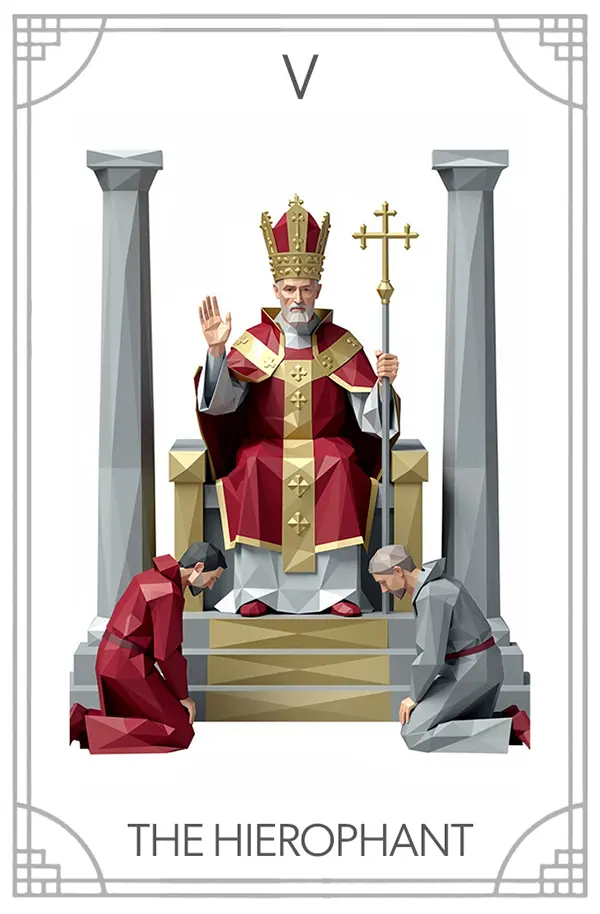
5. The Hierophant
The Hierophant
Keywords
tradition, spiritual wisdom, conformity, mentorship
Upright
Seek wisdom from tradition or a mentor. The Hierophant honors established paths, sacred teachings, and the value of guidance. Trust time-tested approaches now.
Reversed
Rebellion, unconventionality, or restriction from dogma. Question rules that no longer serve you, or honor your own truth even when it diverges from convention.
The Hierophant is the tarot’s card of tradition, shared values, teaching, and finding guidance within a community or established path.
Overview
In the classic Rider-Waite image, a robed religious teacher sits between two pillars, raising one hand in blessing and holding a triple-crossed staff. Two followers kneel before him, while crossed keys at his feet suggest access to learning and spiritual understanding. The scene points to knowledge passed down through teachers, customs, institutions, and communities.
As card 5 in the Major Arcana, the Hierophant follows the Emperor’s focus on structure and turns toward the beliefs and social practices that give structure meaning. In the Fool’s journey, it represents learning from others and discovering how shared values can shape a life. The card is commonly associated with Taurus, an earth sign linked with stability and enduring values; elemental correspondences vary by tarot tradition. Its central message is to consider what you believe, what you are learning, and whether a familiar path genuinely supports you.
Strengths
- The Hierophant can point to a patient teacher, mentor, or community that offers useful guidance.
- It supports commitment, steady learning, and the kind of practice that builds understanding over time.
- Shared values and clear agreements can help people feel connected and secure.
- It encourages respect for experience while leaving room to make thoughtful choices of your own.
Watch-outs
- Tradition can become restrictive when rules are followed without considering whether they still make sense.
- The card may reflect pressure to conform or fear of disappointing a group or authority figure.
- A teacher or institution should not be treated as unquestionable; check advice against your needs and values.
- Reversed, it can suggest rejecting every convention automatically, even when some structure or support would be helpful.
In different situations
Love
Upright, the Hierophant can suggest shared values, a serious commitment, or a relationship supported by family or community. Reversed, it may point to differing expectations about commitment or a desire for a less conventional relationship.
Career
Upright, it favors training, mentorship, professional standards, and learning within an established organization. Reversed, it can reflect frustration with rigid rules or the need to question whether a conventional career path fits.
Money
Upright, this card encourages careful planning, trusted guidance, and dependable financial habits. Reversed, it may invite you to review inherited money beliefs or seek an independent opinion before following familiar advice.
Health
Upright, the Hierophant can point to learning from qualified professionals and following a steady, well-supported routine. Reversed, it may encourage asking questions or seeking another qualified opinion if guidance does not feel right; tarot is not a substitute for medical care.
In everyday life
The Hierophant can show up when you take a course, ask an experienced person for advice, join a group with shared interests, or follow a family custom. It may also appear when you are deciding whether to meet a formal expectation, such as making a commitment or working within a set of rules. Its presence invites you to notice what you are learning from others and decide which teachings deserve a place in your own life.
Tip
Ask whose guidance you are following and whether it reflects values you genuinely share. Keep what helps, and give yourself permission to question the rest.
Frequently asked questions
Is the Hierophant a yes or no card?
It tends toward yes when the choice involves commitment, study, or a trusted, established process. It is less of a clear yes if the situation calls for independence or asks you to ignore your own values.
What does the Hierophant mean reversed?
Reversed, it can suggest questioning tradition, resisting pressure to conform, or feeling out of place in an institution or group. It may also be a reminder to consider whether helpful structure is being rejected along with unhelpful rules.
What does the Hierophant mean as feelings or for someone?
As feelings, it may suggest respect, trust, or a desire for a dependable and committed connection. For someone’s character or approach, it can describe a person who values shared principles, guidance, and familiar customs, though they may sometimes be conventional.
What do the crossed keys on the Hierophant card symbolize?
The crossed keys are commonly read as symbols of access to deeper knowledge, spiritual understanding, or teachings held by a community. They reinforce the card’s themes of learning, guidance, and what is passed down.